An Introduction to the Barrett Values Model and Assessment
Welcome
Building an optimal culture begins with understanding the values that inspire it.
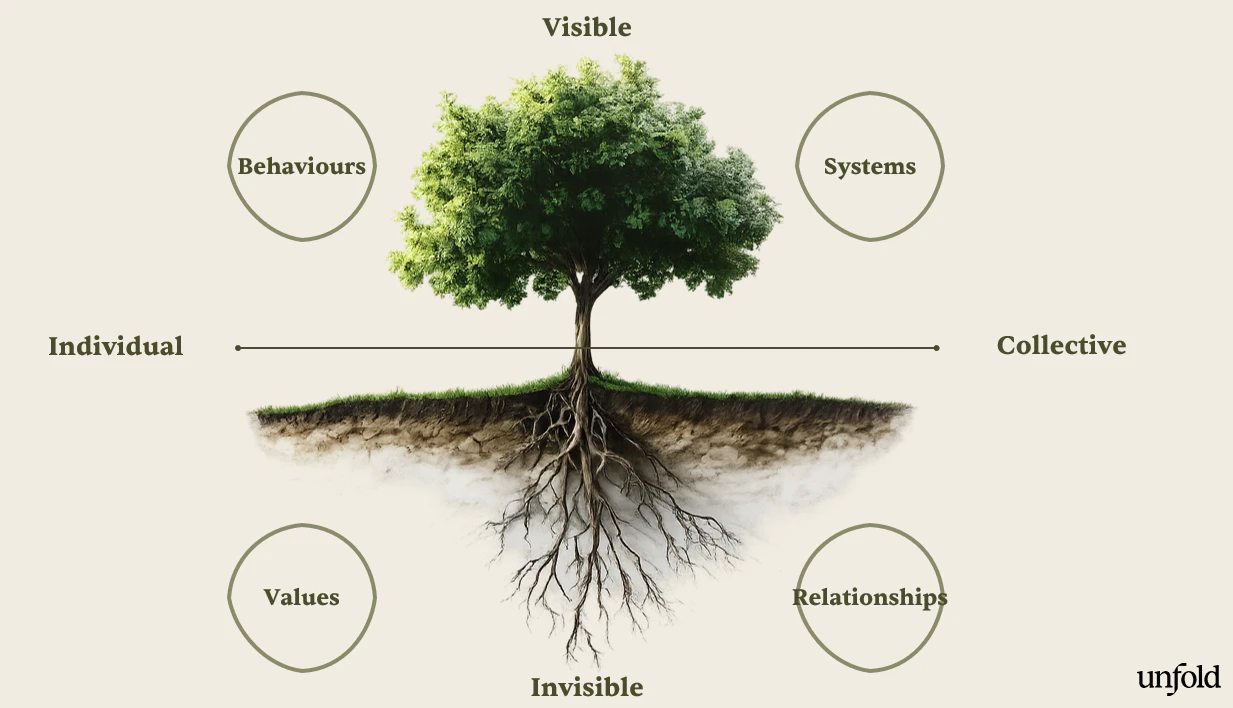
At Unfold, we think about culture as a living system - a bit like a tree. Above the surface, what’s visible are our individual behaviours and collective systems. And below the surface, what we don’t see are our values and relationships.
The visible part of culture is the behaviours people demonstrate and the systems organisations put in place, things like performance frameworks, processes, and ways of working. But just like a tree, we know that what sits above the surface won't survive if we don’t pay attention to the root system - the values people hold as individuals, and the relationships that exist collectively across teams and leadership groups.
These invisible elements shape how people make decisions, how they show up day to day, and ultimately how culture is experienced over time. They align the visible elements of culture, 'how we do things around here', to 'how we really do things around here.'
When these four parts, values, relationships, behaviours and systems, are aligned, culture becomes strong and sustainable. But when organisations focus only on what’s visible and ignore what’s underneath the surface, the system becomes fragile, and that’s often when we start to see challenges with engagement, performance, learning and retention.
The Barrett Values Model provides a framework for understanding which personal and organisational values are shaping behaviour, and using the Barrett Values Assessment, we can quickly and easily measure and assess the values influencing the behaviours that determine culture.
Supported by a debriefing process, this assessment will help to:
- Drive Transformation: It maps the current culture and identifies gaps to reach a desired high-performance culture
- Engage and retain people: It helps align employee personal values with organisational values, which increases engagement and productivity
- Plan with data: Provides objective, benchmarked data to create actionable improvement plans
The Barrett Values Assessment gives insight into personal, current and desired values of a team or system and will clearly uncover what is important and expected to improve and sustain performance.
Organisations don't transform. People do.
About the Model
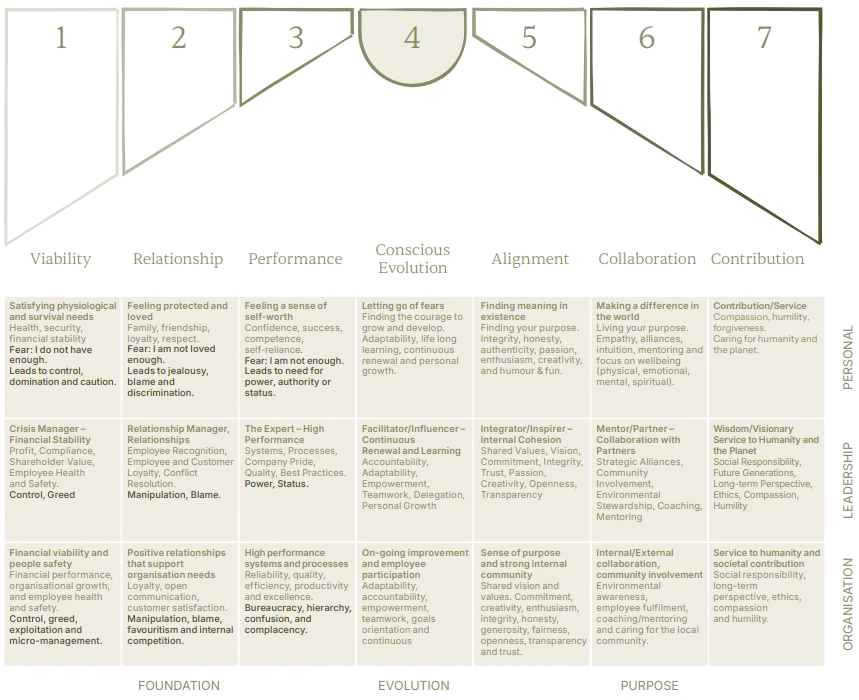
Based on an expansion of Maslow’s Hierarchy of Needs, the Barrett Values Model maps values to seven levels of consciousness which range from basic survival to high-level contribution:
- Viability (Survival, financial stability, health)
- Relationships (Communication, belonging, respect)
- Performance (Excellence, goal orientation, achievement)
- Evolution (Adaptability, continuous learning, accountability)
- Alignment (Shared vision, integrity, commitment)
- Collaboration (Community involvement, empathy, mentoring)
- Contribution (Long-term sustainability, compassion, vision)
About the Assessment
The assessment is a simple 3-question survey that provides a grounded, comprehensive, and actionable map of team and individual motivations, measuring deep-seated values and Cultural Entropy (dysfunction/fear-driven energy). The survey measures three core perspectives asking participants to select 10 values each for three areas to map alignment to:
- Personal Values (PV): What is important to the individual
- Current Culture Values (CCV): What is experienced in the organisation today
- Desired Culture Values (DCV): What is wanted for the future to be successful
Two key metrics are gained from this assessment:
- Values Alignment: The assessment reveals the gaps between current behaviors and desired future state, helping to pinpoint necessary actions
- Cultural Entropy: This is a crucial metric indicating the amount of fear-driven, unproductive energy within an organisation (e.g., bureaucracy, blame, confusion). Low entropy (below 13%) signifies a high-performing, healthy culture
We support individual, team and organisational evolution to create great workplaces.
Implementation Process
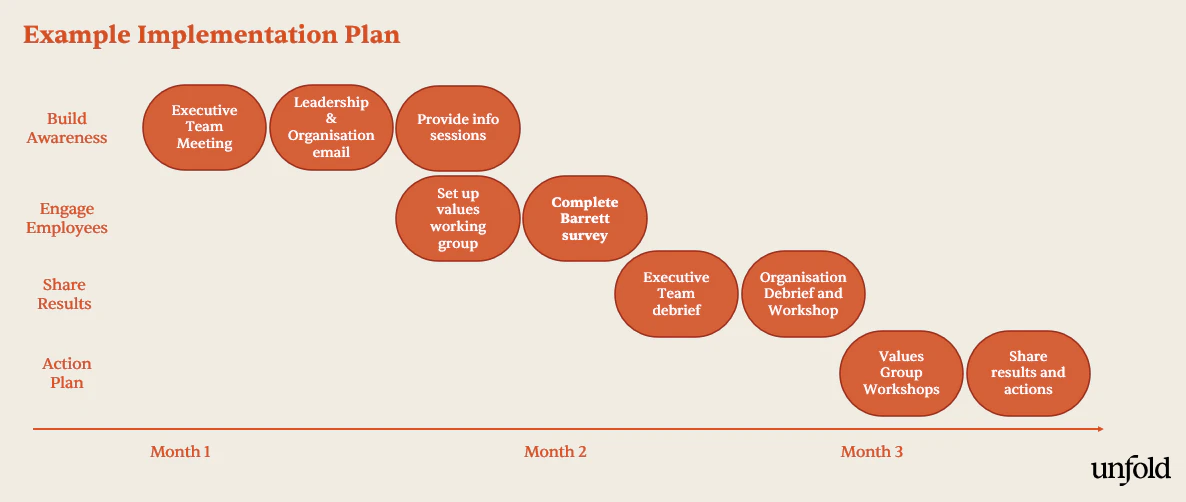
At Unfold, we use the Barrett Values Assessment in different ways - it might be a full values refresh or values development project or a culture assessment process designed to identify success and improvement areas of a team or whole organisation. Depending on the organisational needs and desired outcomes, we will always co-design the most appropriate approach and use of the data. We recommend these core steps for all projects:
- Build awareness
- Engage employees
- Share the results
- Action plan
Building awareness will always involve a variety of communication pieces. These might be via face to face sessions, emails, at toolbox meetings or all staff forums. Here we encourage you to communicate the why and what you are doing to generate awareness.
Engaging employees is an important step to ensure sustainable change and return on your investment. At this point, you are building desire and intrinsic motivation to be a part of the values and culture work. You might tailor your efforts depending on your overall outcome. Some ideas for engagement are:
- establishing a values working group
- providing additional learning to leaders
- setting up a champions league to lead the work
Part of the engagement process is completing the online Barrett Values Assessment, the 3-question survey that takes 10 minutes to complete. The more responses, the more accurate the picture of the values and patterns that are driving behaviour. The survey will usually remain open for 2-3 weeks. Access to the online survey in through a common link that can be sent to anyone via email. Once the survey has closed it's time to start sharing the results.
Sharing the results through a debriefing process, is the best way to ensure your people see the results, understand the data and have an opportunity to contribute to the conversation. This can include 1:1, small team or large format workshops. An initial debrief will always be completed by one of our accredited team. Subsequent debriefs might require our support or we can provide you the resources to share the results in a way that suits you. We recommend some or all of these:
- Executive Team debrief
- Senior Leadership Team debrief
- Whole organisation debrief and workshop
- Team debriefs and workshops
Our debriefing methodology is centred around three key components:
- Awareness – getting clear about context and goals, and understanding the model and data
- Acceptance – making sense of the results and working with how the results present day-to-day
- Action – setting clear and co-designed from-to shifts based on the data
Action planning and developing implementation plans will come as a results of the debriefing and workshopping process and will be co-designed to meet the overall goals and objectives.